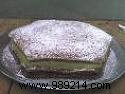
History: At the turn of the 20th century, the 'Russian cake' emerged in France. Created by P. Lacam in 1908—as noted in the historical and geographical memorial of pastry (dating it to 1895)—it was also documented by Darenne and E. Duval in 1909's treatise on modern pastry, and by P. Quentin in 1921's The Country and City Pastry Chef. All describe its signature fluted mold and almond base.
In 1925, Adrien Artigarrède, from Bescat in the Pyrénées-Atlantiques, settled in Oloron-Sainte-Marie after working in Biarritz and Luchon. He acquired a local patisserie selling a version of 'Russian,' but the true recipe—guarded by the Artigarrède family—remains a closely held secret, widely imitated across Aquitaine, Hautes-Pyrénées, and Gers. Today, Oloron claims it as a specialty.
The name sparks curiosity: legends include a Russian refugee sharing the recipe, Crimean almonds (prized for quality), or its snow-dusted look evoking Russian plains.
Description: This square delight measures 7 cm per side (80 g) or up to 30 cm (620 g), or rectangles 30-40 cm x 20-30 cm x 1.5 cm thick (460-840 g). Two airy, earth-toned almond-hazelnut meringue layers sandwich a light beige, melting mousseline cream. The top is dusted with icing sugar, edged with a scalloped piping, and labeled 'Russian' diagonally.
While the exact Artigarrède recipe is proprietary, here's my reliable version, honed through years of baking. Difficulty: 4/5
Buttercream (500 g): 250 g soft butter, 5 cl water, 140 g powdered sugar, 2 eggs + 2 yolks. Cream butter. Boil water-sugar to 120°C ('small ball'). Whip eggs/yolks to foam; pour in hot syrup slowly. Cool, then whip in butter until smooth. Chill.
Pastry Cream (500 g): 1 vanilla pod, 30 g cornstarch, 80 g powdered sugar, 35 cl milk, 4 yolks, 35 g butter. Scrape pod; mix starch, half sugar, milk, pod/seeds. Boil whisking. Whip yolks with remaining sugar; temper with hot milk, cook to boil. Cool over ice to 50°C, whisk in butter. Chill.
Enjoy as dessert, with tea, or Jurançon white wine.