Even with non-stick frying pans, food can stubbornly adhere to the heated surface, despite using oil—leading to messy, unappetizing results. Researchers from the Czech Academy of Sciences delved into the behavior of oil films on flat surfaces like pans, uncovering convection as the key culprit behind this frustrating issue.
In their rigorous experiments, scientists used a non-stick pan coated with ceramic particles. A high-speed video camera captured the heating process, precisely measuring how dry spots formed and expanded. Identical results emerged with a Teflon-coated pan, confirming the phenomenon's consistency.
“We’ve experimentally pinpointed why food sticks to the center of the skillet,” explained lead researcher Alexander Fedorchenko. “It stems from thermocapillary convection creating a dry spot in the thin sunflower oil film.”
When heat rises from below, it generates a temperature gradient across the oil film. For oils like sunflower, surface tension drops with rising temperature, producing a gradient that pulls liquid from the hotter center toward the cooler edges.
This drives thermocapillary convection, depleting oil from the center. Once the film thins below a critical threshold, it ruptures, exposing the pan surface.
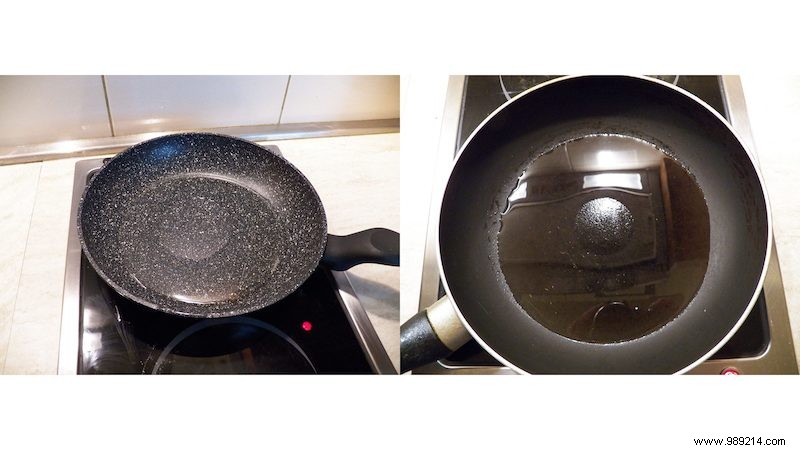
Credit: Alex Fedorchenko
The team identified precise conditions triggering dry patches in both static and flowing films: local thickness dropping below critical levels or deformed areas shrinking under the capillary length.
“To prevent dry spots, increase oil film thickness, heat moderately, fully coat the pan surface with oil, opt for thick-bottomed pans, or stir regularly,” advised Fedorchenko.
This effect extends beyond cooking to applications like fluid distillation columns and electronics cooling, where dry film rupture causes dangerous overheating. “It poses risks to sensitive components,” Fedorchenko noted.
